My Favorite Blog Post(s)

Here are my two personal favorite posts but please check out the others too...


Sunday, January 29, 2012

Perseverance Pays Off


Despite his stellar performance and effort- they lost


This weekend I watched a couple of sports matches that went down to the wire. First, I saw the Australian Open finals between Djocovic and Nadal which ended up going into the fifth set and lasted more than five hours. Along with that the match was the longest Grand Slam title match in history; a true test of the endurance of both athletes under the hot Australian sun for more than five hours. It was also an example of a rare circumstance when a player loses the first set, but wins the match for the title.

Also today I was watching the basketball game between the Miami Heat and Chicago Bulls where the game went down to 2 or 3 crucial possessions in the fourth quarter. The two Eastern Conference rivals duked it out in Miami, where in the last 8 seconds Derrick Rose took a runner that would have gave them the lead- but ended up missing and losing them the game. Despite the fact that the bulls were down by 11 at one point in the third quarter, they fought there way back in it and almost closed it out.

Devils Thumb: one of the most impressive,
challenging, and rewarding climbing
accomplishments in history
Both of these matches- athough very entertaining - were really examples of perseverance and how far a person is to willing to sacrifice in order to win or reach a goal. This is an American value that I'm sure you've seen a million times that most assuredly extends beyond sports. This includes when Chris McCandless sacrificed his whole external world in order to reach his most important goal, to live off the wild and become completely self-sufficient.

Or when Jon Krakauer tried to climb Devils Thumb, putting his life at risk in the bitter Alaskan cold, ultimately being the first person to climb its East Ridge in history.

These stories of perseverance show that nothing is quite impossible, and that sometimes what you have to give up more than you could imagine to receive what you expected. Even though Derrick Rose didn't quite put his life on the line, he kept is team right with the best players in the NBA all throughout the game, as his final shot alone chose the outcome of the game. Djokovic on the other hand worked hard and sweated for five hours until finally he was victorious against one of the best tennis players in the world. It just shows how sometimes what you most desire (be it winning, any goal you have, or completing a death-defying feat) requires a large amount of effort and persevering through any obstacles are thrown at you.

Thursday, January 12, 2012

Meta-Blog Post

Looking back at the year I've had in blogging clearly shows my improvement. The way I used to go about blogging was to sit down and force myself to blog. This process should be avoided in any creative process, as forcing creativity writing leads to bland or weak results. Instead, I found it significantly easier to write creative blog posts when I was inspired by something. I have written numerous blog posts on New York Times articles I've read, music I've heard, and countless other forms of media that inspired me. I also found that rather than rushing myself to write blogs to meet deadlines, I could space them out and give myself time to write a blog post that I truly felt strongly about.

You can see this progression starting at my earliest blog posts, as two of my first five blog posts were about the NBA lockout in early September. At the beginning of my blog-writing career, I would stare at my computer screen desperately trying to come up with a topic. With basketball on my mind, I resorted to writing about it rather than being inspired by something and writing a truly meaningful post. As I became more experienced, my blogs began to take new forms. I started writing about things that truly made me dig deeper in to topics such as my take on controversial movies (50/50), the decline of good pop music (Music is Getting Worse All the Time), and one of my personal favorites, the connection between hockey enforcers and suicide (Hockey Enforcers).

You can also notice my progression when you look at the thoughtful comments I have received for my more interesting posts. It is very rewarding when I get a comment of approval from one of my classmates agreeing with me or providing new information connected to the topic. Whether the comment is high praise, or even constructive criticism, I am more than happy to get it.

One thing that I have not done enough of, that I plan to do in the future, is tying my posts to bigger American ideas or to our class. Making connections is a very important part of writing blogs, and they make it very interesting for the reader. I feel like in order to be a good writer in any medium, not just blogging, your writing needs to be applicable or connected to other familiar topics. I did this with my Hockey Enforcers post for example, when I drew a connection with the suicides of 3 NHL players and returning soldiers from the middle east and their struggles with PTSD. I have made a lot of improvement as a blog writer so far, but I can't wait to show myself I can improve even more.

Monday, January 2, 2012

The Power of Free-Time


This winter break, with nothing but heaps of free-time on my hands, I found myself in front of a television or computer screen for the majority of my time alone at home. I asked my friends if they did the same with their free-time, and they responded as if it were a competition, "Dude, I spent, like, 6 hours on Facebook yesterday it was awesome."

On new years I made it my resolution to cut back on the amount of time I spent online to make room for non-lazy activities like reading, exercising, walking the dog, etc. Come January 2, I find myself on the computer or watching TV just as much. Although it is still winter break and my lazy actions are somewhat justified, I still find it pretty lame that this is what I resort to when I have free-time.

In a recent New York Times article, titled The Joy of Quiet, it talks about a similar topic: limiting your online distractions, such as television and internet, allows the brain to be less erratic and relax the mind from distractions. The article made a very good point that, "Distraction consoles us and yet makes us miserable," referring to how the diversion of the internet and electronics makes our lives both more convenient yet addicting. Teenagers' and adults' minds alike adapt to the extreme amount of fast-paced information while online, so when we get a free moment we feel the need to go back online. You may not even notice it but you may even go back online minutes after you just logged off. The article also offered the alternative, stimulating your brain without the aid of screens, and how it has only positive effects on your mind and mental state.

I think this article would really help out many Americans, including myself. In our free-time when we mindlessly stare at a screen, we are killing opportunities where we could potentially experience nature, read, or exercise. While my new years resolution might be a difficult one, I think it will really have a positive effect on myself as a whole.

Sunday, December 4, 2011

Enforcers, and the Negative Affects of Jobs


To start, it would help to explain the role of an "enforcer". An enforcer is a term for the unofficial position of scaring and brawling the opponent during a hockey game. Basically if they see any rough play towards their teammates and/or goalie they will respond with more aggression, usually punching or checking the opposing team. The reason this is an unofficial position, is because it is a frowned upon part of the game, as it endorses and provokes violence. Another reason is that this summer 3 of the NHL's known enforcers, Derek Boogaard, Rick Rypien, and Wade Belak, died of either suicide or drug overdose- leading fans to try to draw connections between their deaths and what being an enforcer did to them.
Belak, Rypien, and Boogaard respectively

As CNN put it, "Enforcers, past and present, have 'demons' they have to deal with" (CNN). The role of being an enforcer clearly has an impact on their personality, as in all three aforementioned cases the players resorted to drugs and alcohol to cope with their feelings. Although the three died in different ways, (suicide, drug OD, lethal combination of prescription drugs), the connection is their internal happiness with themselves.

The reason for this, is that being an enforcer, although needed to keep other teams in check or to show a teams strength, is harmful to others physically in addition to the enforcers' own self-image. This can be tied to any job that harms others outside of sports. For example, soldiers feel this "job-insecurity" more than anyone else. It is their job to provide security for the United States, but they after they see the kinds of horrors and atrocities in the middle-east, to kill or be killed, it is not uncommon for returning soldiers to resort to drugs or violence in order to cope with their inner-angst. Soldiers also commonly get Post Traumatic Stress Disorder as another side-affect from their job.

This brings us back to the enforcers. For these men, along with soldiers, their jobs, which are supposed to be their means of money to survive, have negative effects on their mental health. So, how can these negative aspects of ones job be dealt with? Really the only way to prevent it, is to address the problem before or immediately after it occurs. This would mean dealing with depression right away, talking to soldiers about their specific exposures to PTSD, or perhaps more officiating within the NHL on to what extent players can fight. I am by no means against the military or NHL, but I do think that this problem needs to be addressed.

Sunday, November 20, 2011

NFL vs. NBA

For any NFL fans, this season is a treat. With more surprises this season than most of this decade (i.e. the Lions being awesome, the Packers being easily the best team in the league, and the 49ers having one of the best defenses), it's interesting to know that this season almost didn't even happen.

At the end of last season, the league was interrupted a some money-fueled lockout that was ultimately thwarted by the love of the game. Both parties (being the owners and players) made some adjustments and ended up happy on both sides; leading to this heck of a season.

Now, if you don't already know, I am a huge NBA fan and this season is essentially cancelled. The negotiations aren't remotely as easy as the NFL had it; on both sides of the negotiations, factions drew lines that they refuse to cross and thus created an endless standstill. What makes it worse, is that the "lines" that the factions have drawn aren't too far apart, it's just they are so stubborn they refuse to budge.

How was the NFL able to jump-start their season so well, when the NBA's chances at a season look so grim? Could the NBA perhaps learn something form the NFL?

The answer to the first question in my opinion, is an issue of time and money, as you'll probably hear as the basis for most arguments. The NFL had from the end of their previous season to the beginning of the next to meet and discuss the lockout. The NBA on-the-other-hand allowed the CBA to expire on June 30, and declared their lockout on July 1- and didn't meet until August 1 leaving only a couple of months to do so (mlive.com). Also, the players have millions of dollars that they potentially would have made last season that they might not next year. The NFL had something similar- but it was more of an NFL CBA rewrite than a money-free-for-all.

And to answer the second: obviously I hope that a similar circumstance can help model the NBA's lockout- but in this case I don't think it will for the reason that the NFL is simply much different than the NBA. The NFL has 11 guys on the field at a time- but can have a whopping 53 on their roster, while the NBA has 5 on the court and a max of 15 on the team. Also on average NBA players make a significant amount more than football players so they have more at stake. The lockouts are certainly in different situations but I really hope the NBA can pull it together.

Sunday, November 13, 2011

Music is getting worse all the time

Whenever I turn the radio on, I swear it's the same 10 songs playing on 4 different stations. Lady Gaga this, Bruno Mars that: I just can't take it anymore. If the 10 songs were some Beck or Spoon, or perhaps even some good oldies, you wouldn't see me complaining, but rather what's played on the radio is absolute garbage. It's all the same: croony-yet-catchy lyrics, sub-par singing, autotune, and stupid synth breaks. Not to mention every top artist on iTunes right now has the same qualities: young boy/girl, very attractive, and rarely plays an actual instrument.

Nowadays, it seems like pop-music is engineered towards 13-14 year old girls, not really any other groups of people. The lyrics boast severe-alcoholism, carefree attitudes, and "hooking up" with the opposite sex. But despite this, videos of these artists (i.e. Justin Bieber, Gaga, ...) rack up 10's of millions of views.

The reason for this, in my opinion, is less about the actual music (which quite frankly has to be terrible to every listener), but about marketing. Girls listen to the pop songs about drinking, less because of their love for the song than because the song is about partying and not liking the song jeopardizes their appearances to their friends. If you look closely at many pop songs, they have a very similar appeal.
music loudness
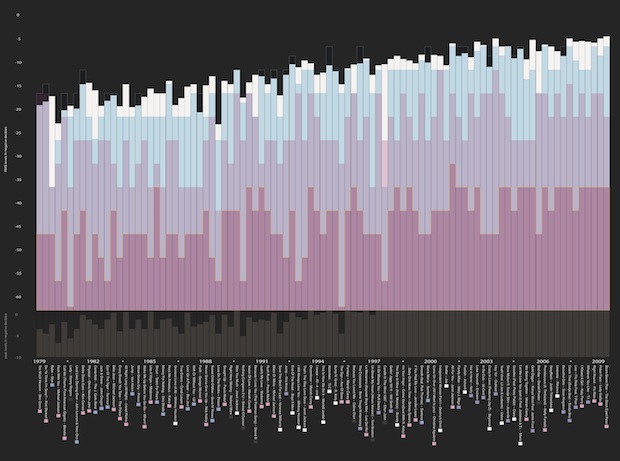
The "Loudness of Hit Singles and When They Were Made" graph

Or you can look at the bad-sounding pop industry in another light, that music is not getting worse and that it's getting louder. On this graph from NPR, it shows how popular songs are getting louder, starting with the 70's and getting up to the late 2000's each hit single louder than the next. Yes you can't prove how good a song is, but you can draw from the loudness, that noise is needed to compensate for the lack of musical content.

Sunday, November 6, 2011

The Spotlight


In today's New York Times, I read a very well-written column by Frank Bruni that I thought played on what I've been emphasizing in my most recent blogs. The title of the column was "The Invention of Outrage", and it gave a satirical analysis of current news; including the Kardashian divorce, disputes in congress, greece, and CNN. Bruni does a good job in explaining each topic and why people should become shocked or outraged with it, but mostly helps you realize which things are getting a too much or too little attention.
Can someone please explain to me
why she is so popular?

Although with our friends we moan and groan over the spotlight on the Kardashian's mishaps, we all crave to witness their rich, luscious, lifestyles and to watch their failures on television.I think the root of all this is less to the fault of the media, but more as a somewhat true stereotype of Americans.

When you see the details of Kim Kardashian's divorce in every possible news channel, newspaper, online news blogs and whatnot, and not an even measurable comparison of the spotlight on the economic situation in Greece: you can't help but ask why some news pieces get more attention than others.

Which brings me to my big topic: spotlight. Why does America love to see relationships and breakups blown out of proportion while they couldn't care less politics? It's almost as if people are forgetting that politicians are the ones who are making crucial decisions for our country and Lindsay Lohan is, in fact, commander in chief. The reason for this is how much you see of a particular subject, and how much we as a country react to it.
The media has the ability to choose what you see and find out for the day, so whatever they choose not to show you ends up whizzing by you. This could be in terms of political or world news (i.e. one news story over another in terms of its' relevancy), or in more "American" news when the stories with the spotlight has the most whining, "trainwrecks", and drugs/alcohol are usually chosen over the ones with the more relevance.