First off, yes the blog count for second semester was lower than first semester. And although not quite an excuse, yes Junior Theme and other deadlines in between were attributed to this.
Having said that, where the quantity of blogs this semester has visibly decreased, the quality has improved extremely. Take an early blog this semester, for example, on the sampling of music Sampling or Stealing?. Although an interesting topic and a good comparison of videos with musical sampling, I did not conduct nearly enough research. In fact I was told after I had already written the post that my argument in the post was invalid as there already exists rules on piracy and sampling.
Now, when you look at my most recent post What is the American Dream?, pondering the composition of the American Dream and how money shouldn't be the tell-tale sign of success. Rather, in this newest post I made a reference to topics we discussed in class and gave a connection to American Ideals that should be rethought.
I think I did a great job in terms of writing quality blogs this semester, and other than the fact that there weren't too many of them, I am happy with my work.
After watching the movie "Citizen Kane" and reading the book "The Great Gatsby" in class recently I have had to some rethinking of the "American Dream". Both stories feature fabulously rich men, Jay Gatsby and Charles Foster Kane, who despite their vast sums of wealth were ultimately very lonely and unhappy. The common goal for every American is to get rich, but is success determined by how much money you have? Or is it how happy you are? To begin to answer these questions I think I should first re-define the American Dream in my own words.
Before being immersed to these two works of art, to me the the American Dream was going to college, getting a degree, getting a good job, make a lot of money, and then settle down with a girl and buy a house and have a couple kids. This seems pretty cliché and perhaps universal but I feel like no ones lives come this easy. This list may very well be the perception of the American Dream, but what if the job in which I make a lot of money makes me miserable? Will the money I make be worth it, as money makes people happy? To what extent should one sacrifice happiness for superficial objects?
If Charles Foster Kane can't buy happiness nor can you!
The American Dream should not be defined by a list of wants based on financial goals. Rather, I believe the American Dream is being happy in your own skin no matter how rich or poor you or. I think people can fall into the trap that with money comes happiness, but you can't buy happiness. Love and happiness cannot be bought, and for that reason the American Dream should be rethought so that there are other factors in people's aspirations besides money.
Having said that, you can buy things that could lead to potential happiness; you can buy security, luxury, possessions, and even sex- but there are all short-lived avenues of happiness. Love and happiness are eternal, and for that reason Kane and Gatsby were very unhappy individuals. They thought that material objects and possessions could buy them love, but in the end they died lonely and their lives unfulfilled. Americans have a bad habit of putting money as their first priority, and although it is a necessity in becoming successful, our character and happiness with ourselves is a far more important priority.
They don't require gasoline. They have a tremendous fuel economy. They could potentially save our skyrocketing CO2 emissions. But no, Americans are not ready to accept the electric car into their lives just yet. Many models and concept cars have tried in the past- the Chevy Volt, the Tesla, and the Nissan Leaf among others- without much success. Perhaps the biggest roadblock electric cars need to face is not so much the larger amount of initial pay, but the fact the Americans don't like change. According to Forbes, the average KWH (Kilowatt per hour) is $0.11 versus the $4.00 per gallon of gasoline. This adds up in the long run, and should be very appealing to Americans who need to save money. Yes, electric vehicles are more costly than standard models, but they should pay for themselves after a year or so. The main reason Americans aren't biting is because the concept of a car that you can charge not refuel is too different.
American men (and women even) love the manly appeal of a loud exhaust in a car, whereas electric cars are silent. Not to mention EV's don't have nearly the horsepower or torque of your pick-up truck or muscle car. For this reason EV's appear feminine and weak to countless car lovers in the U.S. Also, Americans are afraid of the new idea of having to recharge their car. The dramatically different concept of plugging your car into a charger rather than filling up your car from a pump at a gas station is alien to Americans. For this reason, and many others involving the irregularity of the use of an electric car, Americans are unwilling to invest in a more expensive vehicle that is so new to them.
The Chevy Volt, also known as the
Chevy Joke
I also feel like Americans have a huge dependence on natural gas. When we think of our daily or weekly expenses on necessities, (depending on how much you drive) gas costs exceed nearly all other costs. This is why gas companies have become so strong; that they have a stranglehold on car-driving Americans. The vast introduction of EV's would intimidate American gas "giants" along with Americans who have used gas for so many years.
There are many other very legitimate cons to EV's, but I found that most other reasons are technical and criticize the range of electric cars or the lack of infrastructure for charging them and whatnot (Bankrate). Although these reasons are valid, in my opinion Americans are less afraid of the technical aspects of EV's than the are the obscure concepts that come along with it. I think this goes along with the American ideal of normality, and a lack of obscurity. This doesn't apply to just electric cars; Americans don't like radical changes in their everyday lives. Electric cars may be good for our economy and environment, but the American ideal of not diverging from the "norm" prevents the EV business to move forward in the U.S.
It has come to my attention during my research for my Junior Theme question ("Why is the NBA predominantly African-American?) that there is a very common conclusion, or stereotype rather, that quite simply black people are better athletes than white people. Although I do not agree with this, people who do believe this conclusion would say that black people became better athletes from slavery when the stronger and healthier slaves thrived more than weaker ones and hence was an example of evolution. To give their side even more credibility, there is a historical study that supposedly 200,000 years ago the first human population in Africa split, and the population that remained in Africa developed genetic variations increasing muscularity and fitness (paraphrased from NY Times review of Taboo).
First off, it would take an enormous amount of time longer than 200,000 years to create any significant genetic mutations. Furthermore, the genetic makeup of each and every single human on Earth is 99.9% identical, so the variations, if any, aren't much. And to claim that in the period of slavery of Africans (roughly 400-500 years) that any adaptations were made is absolutely preposterous.
So with not nearly enough time for African-Americans to adapt, then how are they better athletes, Casey?
Well, in my opinion, they aren't. I believe that there other factors at play here besides athleticism. I think it's very important to first dissect what is needed to play basketball. Unlike most popular outside sports, all you need to play are sneakers, a ball, and relatively small court. In densely populated inner-cities, there aren't many open fields (for soccer, baseball, football, etc.) if any, however basketball courts are a commodity on nearly every street corner. It's also important to note that in inner-cities it tends to be segregated (especially in Chicago) and African-Americans live in these lower-income big city neighborhoods. So in this case it would be fair to claim that African-Americans in big cities tend to be playing basketball more than higher-income whites for example.
Carmelo Anthony overcame poverty in Baltimore to become on of the NBA's greatest stars
Having said that, I think that the playing field for all athletes, black and white, is completely even. I do believe that poor African-Americans have a larger opportunity to play basketball as they have narrower options for sports, and in many cases use playing on the court as a means to escape gang violence, drugs, or poverty at home. To prove my point, if you look at many of the superstar basketball players, the trend shows that they have had rough upbringings (Carmelo Anthony grew up in the very poor and dangerous part of Baltimore and Dwyane Wade and Derrick Rose each grew up in the south side of Chicago just to name a few).
Stay tuned for more deep blog posts like these.......
Best-selling novelist, Rhoden, could be a potential interviewee
So the current front-runner for my Junior theme topic is, "Why is the NBA 85% African-American?" Yes, this is subject to change, as other options come about and others fade, but I think this is a very interesting topic for a variety of reasons.
First off I love basketball, especially the NBA. For this reason it won't be hard to stay interested and focused on my research. I love watching it, but I also like learning about earlier eras and how the game has changed. Secondly, I believe that this "why" question doesn't have a right answer. While some may immediately conclude that this phenomenon is a testament to physical superiority, I believe that there are also cultural, economic, and historical factors that apply to this open-ended question. Or perhaps I could try to prove in my paper as to why black people are better athletes, tracing it back hundreds of years to slavery. I could compare the NBA now to what it was in the 1950's- or perhaps even earlier when black people weren't even in the league.
This could also be a terrific interviewing opportunity. I could talk to former basketball players, maybe even former Bulls players, about their experiences in the NBA and any racial hurdles they had to face. I could talk to players who didn't make it far playing basketball and draw a claim in my paper as to why. Or I could take a different path completely and could interview writers like, William C. Rhoden, who have already tackled the debate of the black athlete to get an expert's outlook.
This is just the beginning. Stay tuned for more posts strikingly similar to this one. Baer, out.
Yesterday New Trier hosted a "friendly" track meet, in which 5 teams from Cook county (sorry kind of forgot which teams exactly) came and ran a non-scored race at our indoor track. In my 400 meter sprint heat, a senior at Mather High School and I had a very brief conversation about New Trier. He first pointed out the size of the New Trier field house. Here's how the conversation went for the most part:
"Damn dude this gym is at least half the size of my whole school!" he said very enthusiastically.
"We don't mess around, hey!"
I chuckled then said, "You're kidding right? Wait 'till you see the rest of it. I got lost here all the time when I was a sophomore."
The conversation continued briefly and then stopped as soon as it began since we were rivals in a race about to compete against each other. The thing is, that even after the race, what he said about New Trier really got me thinking about how privileged the over roughly 4000 students currently attending New Trier are.
You can walk down any hallway, or look in any classroom and the results will be the same: you will immediately notice how unbelievable the New Trier campus is. What's more is that just under 99% of its students finish all four years of high school, and 97% go to college. Compare that to the national average of 55.5% graduating high school. That statistic is pretty amazing, but what I found very strange was that I hadn't really noticed how unbelievable the school I went to was when I was shrouded by its walls 5 days a week.
The bottom line of this post is that sometimes you don't notice how privileged you are when you are surrounded by the things you are most privileged by. I am thankful for the school I go to, and also for the kid I raced against for helping me re-realize my surroundings.
One of my favorite rappers, let alone musical artists, goes by the name of Kanye West. Despite his incredulous ego, fiasco at the Grammys last year, and horrific album, 808's and Heartbreak, I still love his style and in my opinion he is one of the most influential rap artists of the last decade. Kanye West's career began as a hip-hop producer who used a highly popular method called, "sampling"- when an artist takes a hook or riff from another song to create a new original one. Even though sampling is in a sense taking from what has already been made, it takes a lot of skill to make it work in the way Kanye West does, as he often turn soul classics from the 70's to modern urban hip-hop anthems.
I can see why many criticize this form of music-making: it's easier to make songs as a significant portion has already been made, and that it is "stealing"somewhat from the original song. One could also argue that, in some cases, sampling violates recent piracy acts. This brings up an interesting debate about the fuzzy line between sampling and stealing.
Before I can even begin to create a hard line between these two I need to ask a crucial question: how far must an original piece of music be altered in order to become its own new piece? Must the song undergo significant rhythmic or harmonic changes throughout the song, or can one single note change make it a new song? Can the edited song simply be called a remix? Or can it be given a new name despite the minor differences?
The answer to all of these questions are opinion-based, as different people have different assessments of the boundaries of music. In my opinion, a song is its own original song when it does not simply copy another, but rather uses another for inspiration or even as a backbone for new creative additions. For example, in the Kanye West produced song, The Food, featuring himself and the rapper Common, he clearly uses a piano riff from Sam Cooke in the song, Nothing Can Change This Love, and yet the song is still original and equally creative as the other.
If you listen to the Sam Cooke song, it's clear
that Kanye used the piano riff throughout the song
To sum it up, I do not think sampling is taking the "easy way out". Obviously, if a song rips off an entire verse or blatantly mimics another song it isn't acceptable; but if the producer does it in a way that does not steal from or copy another and uses his/her own creative input then I encourage it. I don't think laws should be made restricting the boundaries of music-making, rather I feel like it should be policed by ones own morals.
Despite his stellar performance and effort- they lost
This weekend I watched a couple of sports matches that went down to the wire. First, I saw the Australian Open finals between Djocovic and Nadal which ended up going into the fifth set and lasted more than five hours. Along with that the match was the longest Grand Slam title match in history; a true test of the endurance of both athletes under the hot Australian sun for more than five hours. It was also an example of a rare circumstance when a player loses the first set, but wins the match for the title.
Also today I was watching the basketball game between the Miami Heat and Chicago Bulls where the game went down to 2 or 3 crucial possessions in the fourth quarter. The two Eastern Conference rivals duked it out in Miami, where in the last 8 seconds Derrick Rose took a runner that would have gave them the lead- but ended up missing and losing them the game. Despite the fact that the bulls were down by 11 at one point in the third quarter, they fought there way back in it and almost closed it out.
Devils Thumb: one of the most impressive, challenging, and rewarding climbing accomplishments in history
Both of these matches- athough very entertaining - were really examples of perseverance and how far a person is to willing to sacrifice in order to win or reach a goal. This is an American value that I'm sure you've seen a million times that most assuredly extends beyond sports. This includes when Chris McCandless sacrificed his whole external world in order to reach his most important goal, to live off the wild and become completely self-sufficient.
Or when Jon Krakauer tried to climb Devils Thumb, putting his life at risk in the bitter Alaskan cold, ultimately being the first person to climb its East Ridge in history.
These stories of perseverance show that nothing is quite impossible, and that sometimes what you have to give up more than you could imagine to receive what you expected. Even though Derrick Rose didn't quite put his life on the line, he kept is team right with the best players in the NBA all throughout the game, as his final shot alone chose the outcome of the game. Djokovic on the other hand worked hard and sweated for five hours until finally he was victorious against one of the best tennis players in the world. It just shows how sometimes what you most desire (be it winning, any goal you have, or completing a death-defying feat) requires a large amount of effort and persevering through any obstacles are thrown at you.
Looking back at the year I've had in blogging clearly shows my improvement. The way I used to go about blogging was to sit down and force myself to blog. This process should be avoided in any creative process, as forcing creativity writing leads to bland or weak results. Instead, I found it significantly easier to write creative blog posts when I was inspired by something. I have written numerous blog posts on New York Times articles I've read, music I've heard, and countless other forms of media that inspired me. I also found that rather than rushing myself to write blogs to meet deadlines, I could space them out and give myself time to write a blog post that I truly felt strongly about.
You can see this progression starting at my earliest blog posts, as two of my first five blog posts were about the NBA lockout in early September. At the beginning of my blog-writing career, I would stare at my computer screen desperately trying to come up with a topic. With basketball on my mind, I resorted to writing about it rather than being inspired by something and writing a truly meaningful post. As I became more experienced, my blogs began to take new forms. I started writing about things that truly made me dig deeper in to topics such as my take on controversial movies (50/50), the decline of good pop music (Music is Getting Worse All the Time), and one of my personal favorites, the connection between hockey enforcers and suicide (Hockey Enforcers).
You can also notice my progression when you look at the thoughtful comments I have received for my more interesting posts. It is very rewarding when I get a comment of approval from one of my classmates agreeing with me or providing new information connected to the topic. Whether the comment is high praise, or even constructive criticism, I am more than happy to get it.
One thing that I have not done enough of, that I plan to do in the future, is tying my posts to bigger American ideas or to our class. Making connections is a very important part of writing blogs, and they make it very interesting for the reader. I feel like in order to be a good writer in any medium, not just blogging, your writing needs to be applicable or connected to other familiar topics. I did this with my Hockey Enforcers post for example, when I drew a connection with the suicides of 3 NHL players and returning soldiers from the middle east and their struggles with PTSD. I have made a lot of improvement as a blog writer so far, but I can't wait to show myself I can improve even more.
This winter break, with nothing but heaps of free-time on my hands, I found myself in front of a television or computer screen for the majority of my time alone at home. I asked my friends if they did the same with their free-time, and they responded as if it were a competition, "Dude, I spent, like, 6 hours on Facebook yesterday it was awesome."
On new years I made it my resolution to cut back on the amount of time I spent online to make room for non-lazy activities like reading, exercising, walking the dog, etc. Come January 2, I find myself on the computer or watching TV just as much. Although it is still winter break and my lazy actions are somewhat justified, I still find it pretty lame that this is what I resort to when I have free-time.
In a recent New York Times article, titled The Joy of Quiet, it talks about a similar topic: limiting your online distractions, such as television and internet, allows the brain to be less erratic and relax the mind from distractions. The article made a very good point that, "Distraction consoles us and yet makes us miserable," referring to how the diversion of the internet and electronics makes our lives both more convenient yet addicting. Teenagers' and adults' minds alike adapt to the extreme amount of fast-paced information while online, so when we get a free moment we feel the need to go back online. You may not even notice it but you may even go back online minutes after you just logged off. The article also offered the alternative, stimulating your brain without the aid of screens, and how it has only positive effects on your mind and mental state.
I think this article would really help out many Americans, including myself. In our free-time when we mindlessly stare at a screen, we are killing opportunities where we could potentially experience nature, read, or exercise. While my new years resolution might be a difficult one, I think it will really have a positive effect on myself as a whole.
To start, it would help to explain the role of an "enforcer". An enforcer is a term for the unofficial position of scaring and brawling the opponent during a hockey game. Basically if they see any rough play towards their teammates and/or goalie they will respond with more aggression, usually punching or checking the opposing team. The reason this is an unofficial position, is because it is a frowned upon part of the game, as it endorses and provokes violence. Another reason is that this summer 3 of the NHL's known enforcers, Derek Boogaard, Rick Rypien, and Wade Belak, died of either suicide or drug overdose- leading fans to try to draw connections between their deaths and what being an enforcer did to them.
Belak, Rypien, and Boogaard respectively
As CNN put it, "Enforcers, past and present, have 'demons' they have to deal with" (CNN). The role of being an enforcer clearly has an impact on their personality, as in all three aforementioned cases the players resorted to drugs and alcohol to cope with their feelings. Although the three died in different ways, (suicide, drug OD, lethal combination of prescription drugs), the connection is their internal happiness with themselves.
The reason for this, is that being an enforcer, although needed to keep other teams in check or to show a teams strength, is harmful to others physically in addition to the enforcers' own self-image. This can be tied to any job that harms others outside of sports. For example, soldiers feel this "job-insecurity" more than anyone else. It is their job to provide security for the United States, but they after they see the kinds of horrors and atrocities in the middle-east, to kill or be killed, it is not uncommon for returning soldiers to resort to drugs or violence in order to cope with their inner-angst. Soldiers also commonly get Post Traumatic Stress Disorder as another side-affect from their job.
This brings us back to the enforcers. For these men, along with soldiers, their jobs, which are supposed to be their means of money to survive, have negative effects on their mental health. So, how can these negative aspects of ones job be dealt with? Really the only way to prevent it, is to address the problem before or immediately after it occurs. This would mean dealing with depression right away, talking to soldiers about their specific exposures to PTSD, or perhaps more officiating within the NHL on to what extent players can fight. I am by no means against the military or NHL, but I do think that this problem needs to be addressed.
For any NFL fans, this season is a treat. With more surprises this season than most of this decade (i.e. the Lions being awesome, the Packers being easily the best team in the league, and the 49ers having one of the best defenses), it's interesting to know that this season almost didn't even happen.
At the end of last season, the league was interrupted a some money-fueled lockout that was ultimately thwarted by the love of the game. Both parties (being the owners and players) made some adjustments and ended up happy on both sides; leading to this heck of a season.
Now, if you don't already know, I am a huge NBA fan and this season is essentially cancelled. The negotiations aren't remotely as easy as the NFL had it; on both sides of the negotiations, factions drew lines that they refuse to cross and thus created an endless standstill. What makes it worse, is that the "lines" that the factions have drawn aren't too far apart, it's just they are so stubborn they refuse to budge.
How was the NFL able to jump-start their season so well, when the NBA's chances at a season look so grim? Could the NBA perhaps learn something form the NFL?
The answer to the first question in my opinion, is an issue of time and money, as you'll probably hear as the basis for most arguments. The NFL had from the end of their previous season to the beginning of the next to meet and discuss the lockout. The NBA on-the-other-hand allowed the CBA to expire on June 30, and declared their lockout on July 1- and didn't meet until August 1 leaving only a couple of months to do so (mlive.com). Also, the players have millions of dollars that they potentially would have made last season that they might not next year. The NFL had something similar- but it was more of an NFL CBA rewrite than a money-free-for-all.
And to answer the second: obviously I hope that a similar circumstance can help model the NBA's lockout- but in this case I don't think it will for the reason that the NFL is simply much different than the NBA. The NFL has 11 guys on the field at a time- but can have a whopping 53 on their roster, while the NBA has 5 on the court and a max of 15 on the team. Also on average NBA players make a significant amount more than football players so they have more at stake. The lockouts are certainly in different situations but I really hope the NBA can pull it together.
Whenever I turn the radio on, I swear it's the same 10 songs playing on 4 different stations. Lady Gaga this, Bruno Mars that: I just can't take it anymore. If the 10 songs were some Beck or Spoon, or perhaps even some good oldies, you wouldn't see me complaining, but rather what's played on the radio is absolute garbage. It's all the same: croony-yet-catchy lyrics, sub-par singing, autotune, and stupid synth breaks. Not to mention every top artist on iTunes right now has the same qualities: young boy/girl, very attractive, and rarely plays an actual instrument.
Nowadays, it seems like pop-music is engineered towards 13-14 year old girls, not really any other groups of people. The lyrics boast severe-alcoholism, carefree attitudes, and "hooking up" with the opposite sex. But despite this, videos of these artists (i.e. Justin Bieber, Gaga, ...) rack up 10's of millions of views.
The reason for this, in my opinion, is less about the actual music (which quite frankly has to be terrible to every listener), but about marketing. Girls listen to the pop songs about drinking, less because of their love for the song than because the song is about partying and not liking the song jeopardizes their appearances to their friends. If you look closely at many pop songs, they have a very similar appeal.
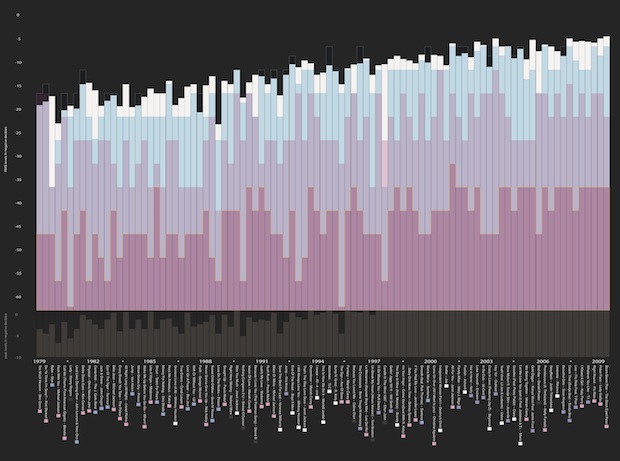
The "Loudness of Hit Singles and When They Were Made" graph
Or you can look at the bad-sounding pop industry in another light, that music is not getting worse and that it's getting louder. On this graph from NPR, it shows how popular songs are getting louder, starting with the 70's and getting up to the late 2000's each hit single louder than the next. Yes you can't prove how good a song is, but you can draw from the loudness, that noise is needed to compensate for the lack of musical content.
In today's New York Times, I read a very well-written column by Frank Bruni that I thought played on what I've been emphasizing in my most recent blogs. The title of the column was "The Invention of Outrage", and it gave a satirical analysis of current news; including the Kardashian divorce, disputes in congress, greece, and CNN. Bruni does a good job in explaining each topic and why people should become shocked or outraged with it, but mostly helps you realize which things are getting a too much or too little attention.
Can someone please explain to me why she is so popular?
Although with our friends we moan and groan over the spotlight on the Kardashian's mishaps, we all crave to witness their rich, luscious, lifestyles and to watch their failures on television.I think the root of all this is less to the fault of the media, but more as a somewhat true stereotype of Americans.
When you see the details of Kim Kardashian's divorce in every possible news channel, newspaper, online news blogs and whatnot, and not an even measurable comparison of the spotlight on the economic situation in Greece: you can't help but ask why some news pieces get more attention than others.
Which brings me to my big topic: spotlight. Why does America love to see relationships and breakups blown out of proportion while they couldn't care less politics? It's almost as if people are forgetting that politicians are the ones who are making crucial decisions for our country and Lindsay Lohan is, in fact, commander in chief. The reason for this is how much you see of a particular subject, and how much we as a country react to it.
The media has the ability to choose what you see and find out for the day, so whatever they choose not to show you ends up whizzing by you. This could be in terms of political or world news (i.e. one news story over another in terms of its' relevancy), or in more "American" news when the stories with the spotlight has the most whining, "trainwrecks", and drugs/alcohol are usually chosen over the ones with the more relevance.
This past weekend I saw an episode of one of my favorite television shows, It's Always Sunny in Philadelphia, that I felt really was a statement to the media. In the episode, the characters of the show are watching the news when an on location meteorologist explains that the largest storm in a decade was heading to Philadelphia. The news piece took place in a WallMart-like place depicting people stocking up as if for a doomsday. And if you know the show, you could probably guess how "the gang" probably responded: unearthing a bunker originally intended for Y2K, one of the characters, Mac, flees for higher ground, and a full-out looting occurs at the WallMart. Of course at the end they discover that the storm is only a drizzle
Despite the fact that this show is a comedy, I like the statement they've made here. The episode was really a mockery of how the media over-exaggerates news pieces to get more views and get a rise out of the viewer. We see this kind of stuff every time CNN is put on or Fox News: over-hyping and somewhat dramatizing disasters, war, and explosions. Anything boring; like peace talks, financial breakthroughs, or scientific discoveries quite possibly won't see the light of day on some channels.
This brings up another interesting point: that perhaps what they choose or choose not to put on the air dictates what stories we hear. For example, if a plane crash happened on the same day of a breakthrough in the peace-talks between North and South Korea, the latter may have not even seen the light of day on most stations. Now, with most people getting their news from the internet, we see less over-exaggerations, as people get a story from multiple different sides and biases. This helps filter out the exaggerations and bias, but also lets you choose the stories you want to hear.
I was watching Real Time with Bill Maher today with my family, and one of the guests, Penn Jillette, made a fantastic point. He claimed that, "Everything is getting better, but everyone thinks it's getting worse." Although Jillette is a comedian, he is completely correct.
Now, take a look at the graph below from the Millenium Project, which takes and analyzes data from the past century and tries to predict future statistics. In every single category, you see a noticeable improvement currently and even educated predictions of upcoming improvements. From literacy to infant mortality, it's obvious that we are on the right track. So why is it that everyone thinks the apocalypse is coming?
So, other than debt way to go world leaders
The reason we think this way is because of all the nonsense we see when we turn on the television: unrest in the middle-east, debts and deficits, huge disagreements between Republicans and Democrats nearly polarizing the nation, famine, natural disasters, murders, you name it- everything awful that is going on in the world is surely going to be documented and force-fed to the public. Americans have a secret obsession with fear and hate. It's not interesting to them to find out the improved population growth worldwide. Americans would rather watch Tsunamis strike terror, and hear about the deficit so they can bark about Obama's job. In order to make money, news channels seek and broadcast these thing to make money, as opposed to accurately documenting the world's condition as a whole.
To me, it's what news doesn't show us that matters the most. Sure, you can always point out terrifying and awful things happening in 2011; but compare present day to 2 centuries ago. 2 centuries ago we had no reliable form of birth control, 1% of the medicine we have today, an extremely low literacy rate, among countless other categories. The world is becoming a better place, slowly but surely and I'm glad we live in this time. Here's some Beatles to lighten the mood.--------->
Today as I was on my Android phone download apps, (which actually means doing absolutely nothing) I noticed that the progress bar was at a standstill at 20%. Even though this standstill was for about 16 seconds, I was not only infuriated, but I actually thought that my phone had broken. And of course, after the long quarter-of-a-minute wait the phone worked completely fine.
I notice these kinds of things all the time with all sorts of online-based technologies. The sad fact is that I'm not alone. Nearly every kid or teenager in the United States has this selfish infuriation: and I have a hypothesis for as to why.
Adults do not have as much of an obsession to extreme quickness, as they have not grown up in the digital-age and also have had more of their adult life to learn to cope with slower internet. Kids and teens (say, born 1992 and on) were born after the world wide web was established and by the time they were using it, had already had access to high speed internet. Nowadays, with ultra-super-awesome speed internet, it seems uncanny to kids and teens to be hampered by even a handful of seconds online.
I think this also goes with the American value of speed and strength over quality perhaps. In America I think we have a habit of choosing the best-looking, fastest, strongest, and definitely biggest things over perhaps the best. You see this everywhere: the flashier it is the more it sells. And online the faster you get to a website (it doesn't matter how good the website actually is it's all about looks apparently) the better.
First off, the blame is to no sides advantage as both sides are both too stubborn to budge with agreements. Players union president Derek Fisher is adamant about getting fair representation for the players, and likewise the owners want to spend less. Next, neither side has an edge, as without players there is no league and without owners there is no money to be made.
It came to my attention that last Monday, the players, owners, and commissioner of the NBA met in New York to have a last ditch meeting to preserve games for the season. According to usatoday, Commish David Stern, "indicated a full schedule is unlikely. 'And every day that goes by, I think we need to look at further reductions,' he said."To no ones surprise the efforts of the meeting went no where despite how long it took (rumored to be 7 hours long).
As of right now, no NBA season in sight
Everywhere I look I see players' reactions. Dwayne Wade claimed it was the owners fault completely and there was no one else to blame. Kevin Durant said something along those lines as well. Before we begin to pick the sides of our heroic star-athletes, I think you should hear the real story.
I just think that…the players should bow down….In 1999 we (were locked out) and missed half the season,"said Dennis Rodman. He wasn't done though. He went on to say, "Most players don't give a [expletive] about the game. They want the money and all of a sudden they want unity. I'm not taking the owners' side. I think the players should look at themselves."(yahoo sports)
The side I choose to support was the side I never thought I would: the owners' and Dennis Rodman's. Although they won't give up, I do realize their argument. When you look at how much players make, it freaks me out (the lowest you can make is around half a million a year, the highest currently at around 25 million). Less money on the players would mean more money for low-market teams and more dynasties can be created. Furthermore, if the players could just throw in the towel now, they'd be able to play a season to some extent! And yet, I have low hopes for my favorite sport.How can the NBA bounce back from this? The lowest ever attendance of the NBA was soon after the lockout in 1999 like what Rodman mentioned, and with an already low attendance from the past 5 years I can't even imagine the upcoming season.
~SPOILER ALERT: I do say a bit of the plot of 50/50, just a heads-up
I went to see the new Seth Rogen movie, 50/50, with my family last night not sure what to expect. I hadn't yet seen a preview, and all I knew was that the movie had Seth Rogen and That Guy From 500 Days of Summer (Joseph Gordon-Levitt).
The movie begins with a fit, handsome, and quirky Gordon-Levitt jogging. The movie does not cut to the chase- you quickly find out he has a job at a public radio station and has a very cute girlfriend, along with back pains. The back pains are none-other than a rare malignant tumor in his back. And the title is a reference the odds of his survival rate for the rare type of cancer he has. The movie actually turns out to be excellent, and I even found myself laughing at moments I never expected I would: for example Seth Rogen (who plays himself in this true story) encourages Gordon-Levitt's character to use cancer to pick up chicks.
What I liked most about this movie was not that it was a compelling true story about a man overcoming cancer. Or even that it had me laughing out loud at countless moments. I liked that it pushed the boundaries of modern cinema and the arts. If you read the plot without seeing the movie, you would most assuredly groan and dismiss it as a disgusting portrayal of America's greatest nightmare: cancer. But instead, this movie was able to play off of what screen-writes thought they could or could not do by even doing so in a tasteful manner. I expected the movie to be swarmed with stereotypical jabs from critics about a comedy with cancer as a main theme, but instead it turned out to be a generally loved movie. I think the reason it hasn't been done before is solely because as I said before people are afraid of cancer. Producers normally wouldn't want to invest in a comedy mixing fear and jokes- but for this true story, it was worth the risk as it gave light to a very very dark subject.
If you haven't seen it yet, you really should consider it for the risks the filmmakers took in making it along with it simply being a great movie.
It came to my attention in class the other day, during our discussion about how people act differently in different situations, that perhaps we don't really know anyone. Every day we put on countless facades, as our true natural personality doesn't fit in with select groups of people. For example, I would never speak to my parents the way I do with my friends and vice versa. My parents could not care less about my friends homecoming plans, and reassuringly my friends would never want to hear a vivid explanation of my day at school. The point is, at any given moment you are changing your persona in order to fit in with a range of variables; relationships (be it a teacher, acquaintance, or perhaps second cousin thrice removed), situations (in front of a camera, or with somebody you want to impress), and physical states(would you act differently desperately needing to use the bathroom than you would with something stuck in your teeth?). With all these personas that people have, it's hard to pinpoint ones most genuine facade.
But how can we ever know ones true personality?
Is it when you're alone? When you're with your friends? Perhaps the genuineness of ones persona is not defined by any of the external factors mentioned above, but rather internal, or emotional qualities. If this were true, I don't think it would be possible to ever truly know someone, as we can never pinpoint another's internal qualities with certainty. Even if someone is crying for example, and our immediate assumption is that he/she is genuinely sad, the person could very possibly be faking or acting.
Yet I do not think this is the case. I think that rather than raising confusion over the genuineness of our personas, it is the facades we choose to use that define us. As we create, reuse, and recreate different facades, we are constantly shaping our inner selves along with our exterior.Rather than dismissing facades as lies, I embrace them as personalities on account of that the fact that a person used a certain mask tells me more about them then they possibly can. As Oscar Wilde puts it, "Man is least himself when he talks in his own person. Give him a mask, and he will tell you the truth."quotationspage.com.